


Every aquarium loses water to evaporation. Some weeks you barely notice it, other weeks the water line drops far enough that the filter starts to gurgle and a white crust appears on the glass. Topping off that lost water takes only a minute, yet it is one of the most misunderstood chores in fishkeeping.
In this guide you will learn why water evaporates faster in some tanks, what actually happens to the water chemistry when it does, which water to use for top-offs, and how to build a quick routine that fits a low-maintenance approach. You will also see how topping off differs from a water change, so you never confuse the two.
Why aquarium water evaporates
Evaporation is simply water turning into vapor at the surface. Several factors speed it up:
- Open tops. Rimless and open-top tanks look beautiful but lose noticeably more water than tanks with a lid.
- Warm water. Heated tropical tanks evaporate faster than unheated coldwater tanks.
- Surface movement. Air stones, spray bars and filters that break the surface increase the area where water can escape.
- Dry, warm rooms. Air conditioning, heating systems and low humidity pull moisture from the tank.
- Lights close to the water. Fixtures that warm the surface add a little extra evaporation.
None of this is a problem in itself. It is normal and simply means you need to replace the missing water regularly.
What evaporation does to your water
Here is the key point that many beginners miss: only pure water evaporates. The minerals, salts and dissolved waste that are in the tank stay behind. As the water level drops, those substances become more concentrated in the water that remains.
In a small tank with a high evaporation rate, this concentration can happen surprisingly fast. Over time it can lead to:
- Rising hardness. Dissolved minerals build up, which can slowly change your general and carbonate hardness readings.
- More concentrated waste. Nitrate and other dissolved compounds become stronger in a smaller volume of water.
- Mineral crust. The white or gray ring on the glass and lid is made of minerals left behind as the water line drops and rises.
- Equipment trouble. Hang-on-back filters and internal filters can run noisily or draw in air when the water level falls below their intake.
That is why the water you use to top off matters, and why topping off does not replace regular partial water changes.
Which water to use for topping off
Because evaporation removes only pure water, the ideal top-off water is as close to pure water as possible for your setup. Your choice depends on the type of tank and your local water.
Freshwater tanks on dechlorinated tap water
For many freshwater tanks with moderate tap water, dechlorinated tap water works fine for small, frequent top-offs. Treat it with a water conditioner just as you would for a water change, and match the temperature roughly to the tank. If you top off with tap water, keep up with partial water changes so minerals do not build up excessively over months.
Tanks with hard tap water or sensitive species
If your tap water is very hard, or you keep fish and shrimp that prefer softer conditions, consider topping off with reverse osmosis water, deionized water or distilled water. These contain very few dissolved minerals, so they replace exactly what evaporated without adding more.
Keep in mind that pure water should only be used for topping off, not for full water changes, unless you remineralize it. Fish and invertebrates need some minerals for a stable environment.
Saltwater and brackish tanks
In marine and brackish setups, salt does not evaporate. Topping off with saltwater would steadily raise salinity, which can stress or harm the animals. Always top off these tanks with fresh, purified water, and use saltwater only for water changes.
Building a minimal top-off routine
The goal of low-maintenance fishkeeping is to keep things stable with as little effort as possible. A simple top-off routine does exactly that.
- Mark the ideal water line. Put a small piece of tape or a discreet marker dot on the back or side of the tank at the correct level. It removes all guesswork.
- Keep a dedicated jug. Fill a clean container used only for the aquarium and leave it next to the tank. Water at room temperature is close enough to tank temperature for small top-offs in most homes.
- Choose a frequency. Small daily or every-other-day top-offs keep conditions steadier than one large refill each week. Many people simply add a splash when they feed their fish.
- Pour slowly. Aim the stream at a rock, the filter outflow or your hand so you do not disturb the substrate or stress the fish.
- Keep an eye on hardness occasionally. If you top off with tap water, testing hardness or total dissolved solids now and then shows whether minerals are building up over time.
Signs your routine needs adjusting
- A visible gap of more than a couple of centimeters between your mark and the water line.
- A thick mineral ring forming on the glass between cleanings.
- A filter that rattles or sucks air.
- Test results that slowly drift even though you change water regularly.
Reducing evaporation without extra gear
You do not need to stop evaporation entirely, but slowing it down makes top-offs less frequent. A few easy, low-cost options:
- Use a lid or glass cover. Even a partial cover can cut evaporation noticeably. Leave a small gap for gas exchange and for cables.
- Lower surface agitation slightly. If your tank has plenty of oxygen and plants, you may not need a strong air stone running all day. Keep enough movement for healthy oxygen levels.
- Check the room. Keeping the tank away from heater vents and direct sunlight helps with both evaporation and temperature stability.
- Set the heater sensibly. Keep it at a temperature appropriate for your species rather than warmer than necessary.
Floating plants also shade the surface a little, though their main benefits are absorbing nutrients and giving fish cover.
Automatic top-off systems: are they worth it?
Automatic top-off (ATO) systems use a sensor and a small pump or gravity feed to add water from a reservoir whenever the level drops. They are common in saltwater tanks, where stable salinity is especially important, and in large open-top setups with high evaporation.
For most small freshwater tanks, a jug and a mark on the glass are enough. If you do consider an ATO:
- Choose a system with a backup or failsafe sensor to reduce the risk of overfilling.
- Use a reservoir sized so that a failure cannot flood the tank with an excessive volume of water.
- Fill the reservoir only with appropriate top-off water, never saltwater.
- Check it regularly. Automation reduces chores, but it does not replace looking at your tank.
Topping off is not a water change
It is worth repeating: adding water to replace evaporation does not remove anything from the tank. Nitrate, dissolved organics and accumulated minerals stay in the water until you take some of it out. Partial water changes remain essential, even in well-planted, low-tech tanks.
A simple way to think about it:
- Topping off restores the water level and keeps concentrations from creeping up.
- Water changes physically remove waste and refresh minerals.
Both work together, and both take only a few minutes when they become habits.
Summary
Evaporation is normal, but the minerals and waste left behind become more concentrated as water disappears. To keep your tank stable with minimal effort:
- Mark the correct water line and top off small amounts often.
- Use conditioned tap water, or purified water if your tap water is very hard or your species prefer soft water.
- In saltwater and brackish tanks, top off only with fresh, purified water.
- Reduce evaporation with a lid and sensible placement.
- Remember that topping off never replaces regular partial water changes.
A one-minute top-off habit protects your fish, keeps your filter running quietly and makes every other part of aquarium care easier.
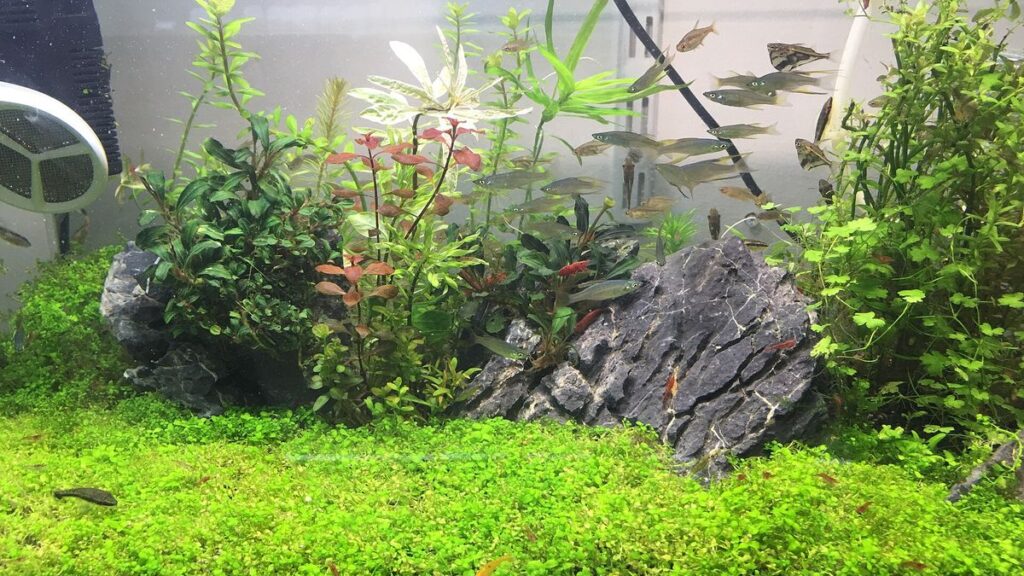
Photo: Freshwater aquarium U.A.E, by Ranjith-chemmad, license CC BY-SA 4.0, via Wikimedia Commons. Cropped.